- 7 Degrees of Freedom
- Posts
- How to build space robots without raising investment
How to build space robots without raising investment

Jack Pearson
August 12, 2022
Welcome to the Bulletin by Remix Robotics, where we share a summary of the week's need-to-know robotics and automation news.
In today's email -
All about drones - design guidelines and drone racing
Out of the frying pan and into the fire - another kitchen robot goes bust
Amazon's not quitting home robotics
How to build a space robots without investment
Better than The Boring Company
Don’t forget to catch last week’s deep dive on the sustainable impacts of robotics and automation
Snippets

Going cold on kitchen robots - Chowbotics — a manufacturer of robot food kiosks — is shutting down 17 months after being purchased by DoorDash. They follow in the footsteps of Zume (raised $423M to build robot pizza makers and recently made an interesting pivot into sustainable packaging) and Spyce (aqui-hired by Sweetgreen). Karakuri and Miso Robotics are still going strong, but this highlights the challenges of kitchen automation - products are soft, variable, and perishable; while restaurants have razor-thin margins.
Going underground - Switzerland’s Cargo Sous Terrain is ready to commence the autonomous transportation of freight in underground tunnels this August. The proposed $35 billion price tag hasn't scared off the Swiss government or suppliers, who claim the concept has a number of advantages over Musk’s Boring Project.
Get ready to re-shore - Last year the US saw a 116% increase in the construction of new manufacturing facilities, a huge increase from 2020 (10%). This should come as no surprise, we’ve been banging on about reshoring and American Dynamism a lot recently - here and here.
Amazon doubles down on home robots - Last year Amazon launched Astro, a £1000 home robot “with a lot of potential, but too little utility to really be worth that price tag”. Despite scepticism and poor reviews, the company is determined to crack personal robotics. “This is the beginning of the journey for us,” said Ken Washington, Amazon’s vice president of consumer robotics, “We’re in this for good”.
Bootstrapping space robots - A great thread on how Lunar Outpost has funded the development of space robots while raising minimal investment. In summary, they built a product for Earth, but one that was fully compatible with the Lunar environment. They’ve now leveraged the profits and reputation to win government contracts for space, including technologies for a future moon base. In this economic environment profitability is the way forward.
More layoffs - Fabric, a micro-fulfilment company with a highly automated logistics process will lay off 40% of its staff and has named a new CEO. Apparently, clients want them to transition from a service model to a platform model. It's not all bad as they have “years of runway” and Fabric “is in a very good situation” according to their new CEO.
The Big Idea

A Framework for Designing Drones
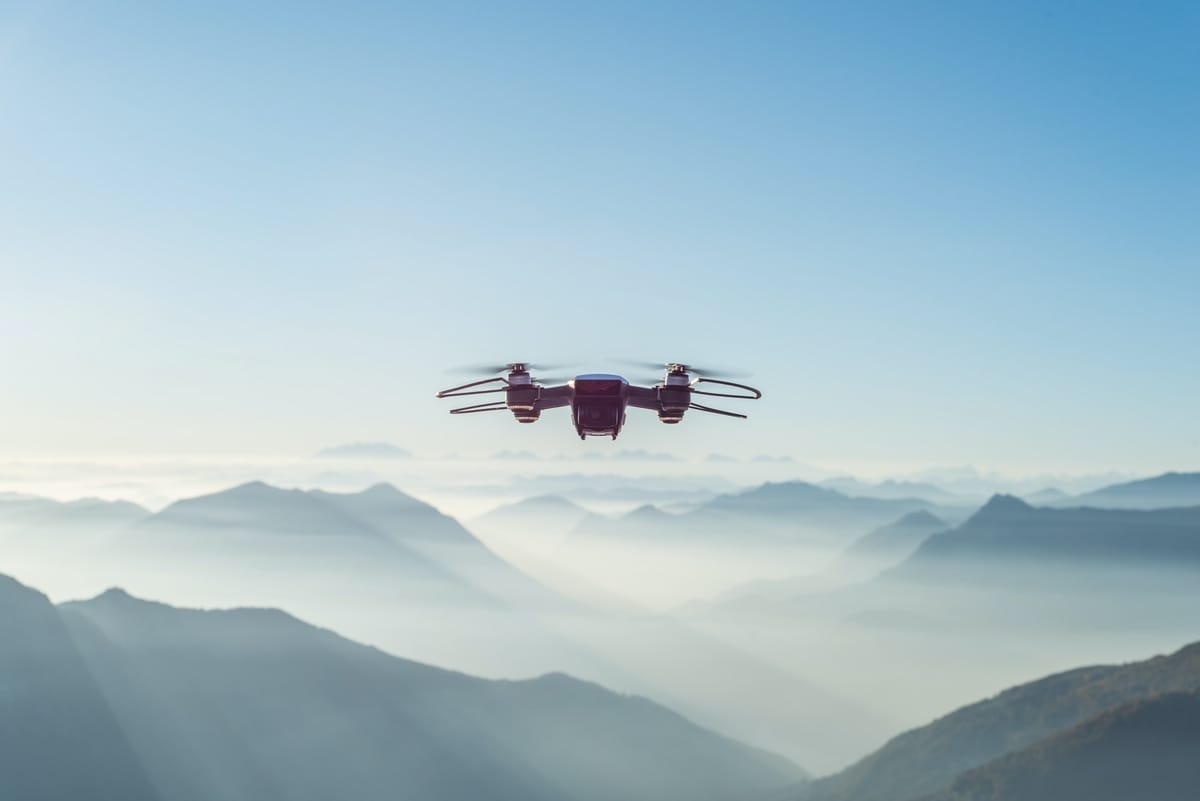
The University of Melbourne has published a paper defining design guidelines for aerial robots. The paper by Tan et al. serves as a useful resource for drone engineers and also acts as inspiration for how to develop design best practices. The paper is behind a paywall, but we’ll provide a synthesis here.
The guidelines

The researchers reviewed 90 cutting-edge drone designs looking for patterns in motivation, features and trade-offs. They identified two consistent priorities -
Maximising SWaP (Space, Weight and Power)
Increasing autonomy in Volatile, Uncertain, Complex, Ambiguous (VUCA) environments

From these priorities, they traced four categories of design efficiency covering fourteen design principles -
Efficient Actuation
Mission Efficiency
Battery Efficiency
Efficient Sensing
Efficiencies 1, 2 and 4 can be grouped together - every additional gram spent on actuators, sensors, computers, batteries etc, results in either -
a. Shorter flight time or
b. Increased thrust requirements, leading to larger / more efficient batteries
To minimise this trade-off it's important to reuse components for multiple functions, use passive or lower fidelity technologies, allow drones to collaborate etc.
Efficiency 3 is more open-ended to account for the variety in drone missions. A drone often needs to interact with complex environments - collecting payloads, navigating tight spaces, etc. Each requirement may lead to different technologies - shapeshifting, collaboration, novel actuators etc.
For a more in-depth review - we recommend downloading the paper.

The robotics industry needs more frameworks
We’re big fans of frameworks - they simplify the design process and stop engineers from reinventing the wheel. To paraphrase the paper - codifying design knowledge increases the chance of a successful solution. Even if your heuristics change, the act of defining them improves the repeatability of your process and highlights flaws in thinking.
The paper’s inductive approach of reviewing academic research could be replicated by reviewing a company's own designs or those of competitors. This process is more of an art than a science and the real value comes from making implicit knowledge explicit. Of course, there are times when you have to reject orthodoxy but you need to know the rules to break them
The researchers applied the framework as a concept generation aid, but it could also be used as a checklist in design reviews, to train new starters, or to reduce the risk of knowledge being lost.
Video
Drones Challenge Humans to a Fair Flight
A year ago, the Robotics and Perception Group at the University of Zurich proved that their autonomous drones could beat the world’s fastest human pilots in a quadcopter race. However, the drones relied on a off-drone motion-capture system to provide position information in real-time, along with off-board computing - doesn’t really seem like fair competition.
Earlier in this month, they held a rematch. This time the rules were fair. No motion-capture system. No off-board computing. Both the drones and humans used their own vision systems and their own brains.
Once again the machines won — by around 0.5 seconds over 3 laps. To put this in context, human vs human races are normally decided by 10ths of a second. Impressive.
Joke of the Week :)

… but it won’t stop us from taking their money ;)
P.S - If you've been inspired by DALL.E 2 check out this guide on how to become a "prompt engineer" and really optimise its use.